Let’s get started.
“Work hard in silence. Let success be your noise.”
– Frank Ocean
This is the first post on my new blog. I’m just getting this new blog going, so stay tuned for more. Subscribe below to get notified when I post new updates.
“Work hard in silence. Let success be your noise.”
– Frank Ocean
This is the first post on my new blog. I’m just getting this new blog going, so stay tuned for more. Subscribe below to get notified when I post new updates.
Running is a strategy for earthbound motion enabling people and different creatures to move quickly by walking. Running is a kind of step portrayed by an airborne stage wherein all feet are over the ground (however there are exceptions). This is rather than strolling, where one foot is consistently in contact with the ground, the legs are kept generally straight and the focal point of gravity vaults over the position leg or legs in a rearranged pendulum fashion. An element of a running body from the perspective of spring-mass mechanics is that changes in motor and potential vitality inside a walk happen all the while, with vitality stockpiling achieved by springy ligaments and uninvolved muscle elasticity. The term running can allude to any of an assortment of velocities going from running to run
Regular running or jogging offers many health benefits. Running can:
As basic as running might be, it surely isn’t simple. Particularly when you’re a fledgling. ‘You need to begin where you are, not where you figure you ought to be,’ says running trainer and exercise physiologist Janet Hamilton. ‘On the off chance that you go further or quicker than you’re prepared for, your body can’t adjust rapidly enough and you’ll get harmed.’ That’s the reason, with plans planned by exceptionally experienced mentor Sam Murphy, we’ve built up a five-section program to take you from your absolute initial steps to venturing up for your first race. All in all, would you say you are prepared?
‘When it’s a propensity, practice feels simpler and doesn’t take as a lot of self discipline when you don’t feel like it,’ says Charles Duhigg, creator of The Power of Habit.
Make an arrangement: Duhigg says each propensity is comprised of a gathering of signals (time, place, music, other individuals); a reward (chocolate, back rub, smoothie); and a daily practice (the exercise). Record your prompts and rewards and post your arrangement some place you can see it.
Keep it normal: Run simultaneously of day and tune in to the equivalent pre-exercise music. ‘The signals must be predictable,’ says Duhigg. ‘You’re making neural pathways that make the action a propensity.’
Reward yourself: Treat yourself to something you appreciate straight after you work out, so your mind partners practice with a prompt reward. ‘You need to show the cerebrum through experience,’ says Duhigg.
Manufacture an emotionally supportive network: Equip your everyday practice with things that will make you feel better, says Duhigg. Run with companions or go to a parkrun, and track your miles so you can see your improvement.
Prior to your first run, get in the ordinary practice propensity by strolling. This ought to be a lively walk – ‘not a race walk, yet not a window-shopping walk either’, says Steven Blair, educator of activity science at the University of South Carolina, US. You can likewise utilize a stationary bicycle or circular mentor, however strolling is a fantastic establishment for running and holds the accommodation secret weapon. ‘The best exercise is the one you will do reliably,’ says Blair.
First Workout: 15 mins
Objective Workout: 60 mins
Is it accurate to say that you are prepared? This arrangement is for any individual who still can’t seem to practice by any stretch of the imagination. It includes just strolling, to give your bones, muscles, ligaments and wellness the base they have to advance to running without damage.
Space to manoeuver: No time for a more drawn out session? Split the week’s longest into equal parts among morning and evening.
*If your BMI is 35 or higher, you’re more than 60, or simply need steady movement, utilize this arrangement for eight to 12 weeks.
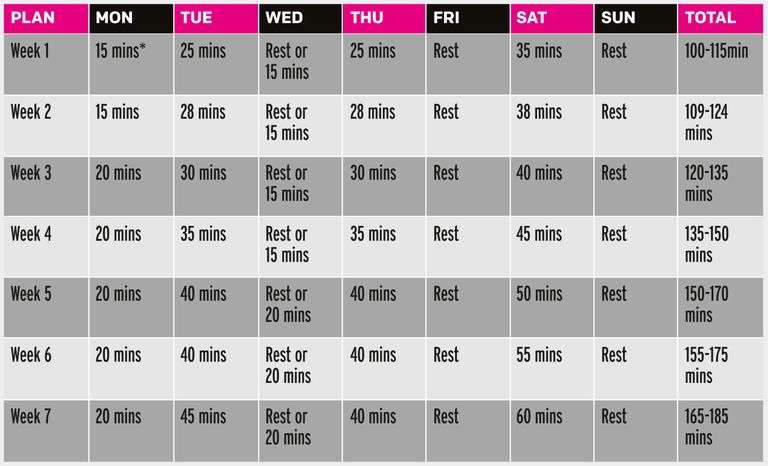
You’re prepared to run. Also, here’s the uplifting news: since you’ll be moving quicker, you’ll spread longer separations without adding exercise time to your calendar. Toward the finish of this seven-week plan, you’ll have the option to finish 175 minutes of activity for every week, running for around twice the length you walk.
A 7-week run-walk plan for learner sprinters:
Length of plan: 7 weeks
First exercise: Walking for 30 minutes
Objective exercise: One hour with run/walk proportion of 2:1
It is safe to say that you are prepared? This arrangement is for the effectively dynamic, including Stage 1 finishers. In the initial two weeks, you’ll practice for around 30 minutes, five days of the week. At that point, in week 3, you’ll start running.
Space to move: If you get yourself prepared for more of a test, you can get a move on: On some random day, work out for a similar measure of time, yet step by step work to a run/walk proportion of 4:2 minutes, at that point 6:3 minutes. In the event that you view the arrangement is moving as too rapidly for you and need to dial it back, you can rehash any week for whatever length of time that you like, until you feel prepared to push on.
picture
Need to fabricate your continuance and take out the walk breaks? This arrangement takes you from run/approaching consistent running. Each run ought to be done at a conversational pace. In case you’re wheezing, slow down.
A 7-week amateur running intend to assist you with running your first 5k:
Length of plan: 7 weeks
First exercise: 30 minutes, with 20 minutes at 3:2 run/walk proportion.
Objective exercise: Run 3.1 miles (5K) consistently
It is safe to say that you are prepared? To start this arrangement, you ought to have gone through at any rate a month and a half run/strolling for approximately 30 minutes, five days of the week, and running in any event double the measure of time you spend strolling.
Space to move: There’s adaptability in this arrangement: if it’s excessively simple, skirt ahead to the following week. In the event that your body’s reaction reveals to you that the preparation is moving excessively quick, go through about fourteen days or more at every week – albeit in a perfect world, you’ll complete the program inside a limit of 14 weeks altogether.

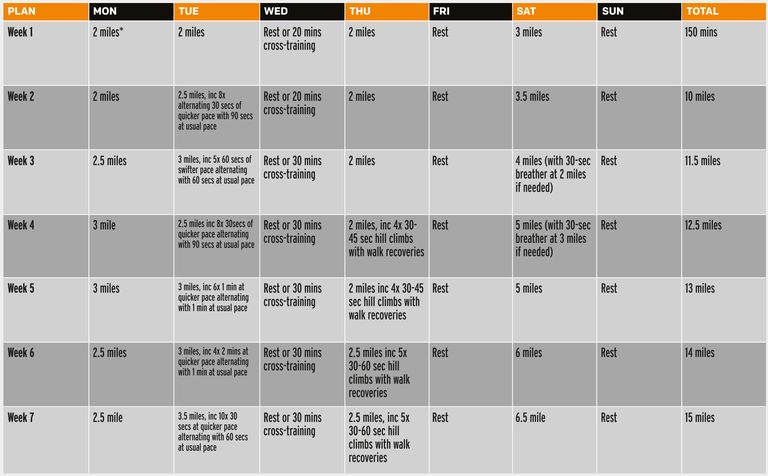
You’ve run a relentless 5K, presently you need to run further. This arrangement will assist you with building up the continuance you have to run a 10K, and fabricate the solidarity to race a 5K. It incorporates a few slopes and inexactly organized speedwork (fartleks) to fabricate that quality.
A 7-week intend to take you from 5K to 10K:
Length of plan: 7 weeks
First exercise: 2-mile run
Objective exercise: Run 6-7 miles ceaselessly so you can either race a 5K or completion a 10K
Is it true that you are prepared? You ought to have been running for in any event 30 minutes, five days out of each week for in any event a month and a half, and have the option to run three miles or 5K without strolling.
Space to move: If you’re prepared for a more noteworthy test, skirt ahead seven days. Be that as it may, don’t surge it. It’s smarter to assemble bit by bit so your body becomes accustomed to the additional heap, as opposed to push excessively hard and hazard time uninvolved with damage. On the off chance that you feel the arrangement’s moving excessively quick, you can rehash any week until you’re prepared to advance. Despite the fact that in a perfect world, you’ll complete this arrangement in 14 weeks.
“Strength does not come from the physical capacity. It comes from an indomitable will.”
– Ghandi
Hi! my name is Salman Khan, i created this site for all the people who want to get fit or want advise regarding to certain sport.

 Live fit, Live better